
Extractables & Leachables (E&L) Testing
- FDA Registration FEI# 1000151293 as a GMP/GLP/GCP Drug Establishment and Cosmetic Facility.
- DEA Registration# RC0199744 (Analytical Lab) | Schedule I-V license | Remember, Schedules I-II require DEA Form 222 | Registration# RC0171568 (Researcher)
- US EPA/NJ DEP Registration# NJD982726648
- ISO/IEC 17025:2017 Accreditation# 80071
FDA has growing concerns over the presence of low-level contaminants being found in US drug products.
One source of these contaminants are Extractable materials that are present in plastic packaging and delivery systems used for drug products.
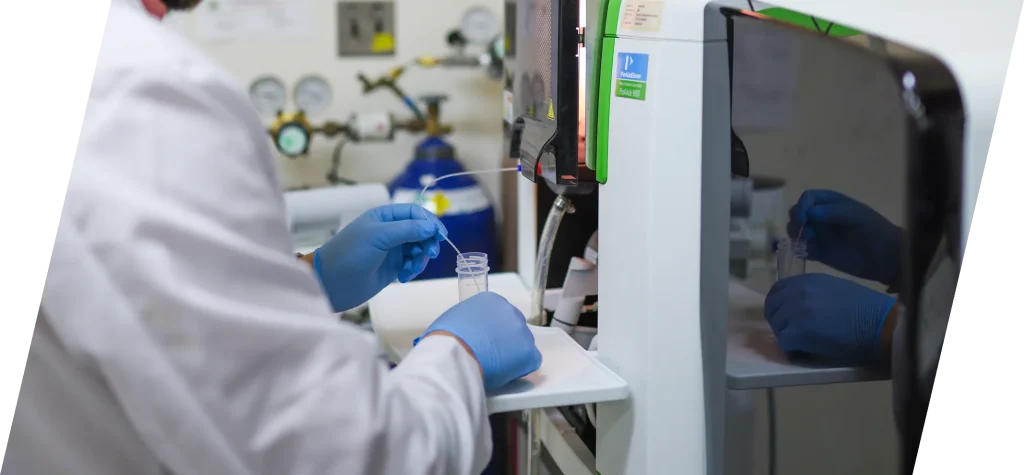
Let’s begin this discussion by establishing a few basic definitions:
Extraction
Extraction is a process of treating a material with a solvent for the purpose of removing soluble substances which are present in that material.
Extractables
Extractables are defined by the United States Pharmacopeia (USP) as organic and inorganic chemical entities that are released from a plastic primary packaging/delivery system and into an extraction solvent under laboratory conditions.
Extractables Profile
Extractables Profile is a listing of the extractables content of a particular material relative to a set of laboratory extraction conditions.
Leachables
Leachables are defined by the USP as foreign organic and inorganic chemical entities that are present in a packaged drug product because they have leached into the product from a plastic packaging/delivery system under ‘normal’ conditions of storage due to direct contact with the product.
We can think of extractables as all of the organic and inorganic chemical entities which can be extracted from a primary packaging/delivery system under laboratory conditions using extraction solvents. Similarly, we can think of leachables as a subset of the extractables, which are the organic and inorganic chemical entities found in a drug product which have been extracted from the primary packaging/delivery system through direct interaction with the product.
Migrants
Migrants are also foreign organic and inorganic chemical entities that are present in a packaged drug product however unlike leachables, migrants do not originate in primary packaging components and are not released through direct contact with the product. Migrants originate from secondary and tertiary packaging and only ‘pass through’ the primary packaging on their way into the product. Since the source of migrants is “outside” of the primary packaging/delivery system, they do not arise from a direct interaction with the product.
(The testing for migrants is conducted in a manner similar to E&Ls but this topic will be addressed in a ‘future’ discussion.)

The Simple Theory Behind Extractables and Leachables Testing
The starting point for Extractables and Leachables testing is the compiling of an Extractables Profile (extractables content) for the plastic packaging/delivery system used for the drug product. This profile may be based upon the results of analytical testing and/or information provided by the manufacturer of the plastic components. Once the Extractables Profile has been created for a packaging/delivery system, the next step is to test for the presence of those extractables within the product.
Extractables Testing
Procedures for the testing of extractables present in plastic packaging materials are provided in USP <661.1> “Plastic Materials of Construction” and <661.2> “Plastic Packaging Systems for Pharmaceutical Use”. The USP also provides useful information relating to extraction schemes in General Chapter <1663> “Assessment of Extractables Associated With Pharmaceutical Packaging/Delivery Systems”.
Common extractables found in plastic packaging materials include:
1
Related Substances
Examples: Residual Solvents, Bisphenol A, and Vinyl Chloride
2
Plastic Additives
Examples: Phthalates, Phenolic and Non-Phenolic Antioxidants, and Amides
3
Metals
Examples: Lead, Mercury, Arsenic, and Cadmium
Leachables Testing
In some instances, methods which have been employed for the testing of specific extractables in plastic materials may also be used for the testing of those same analytes which may now be present within the drug product as leachables. The USP also provides useful information relating to leachables testing in General Chapter <1664> “Assessment of Drug Product Leachables Associated With Pharmaceutical Packaging/Delivery Systems”.
When conducting testing for leachables, it is important that the sample of the drug product to be tested has had sufficient time within its packaging to allow for any extractables to have leached into the product.
Two suitable product sampling scenarios are:
1
Packaged product which has reached the end of its shelf life.
2
Packaged product which has undergone accelerated stability storage conditions for at least 3 months.
CPT℠ Can Assist With Your E&L Testing
Extractables and Leachables testing is a relatively new concept.
Due to a lack of ‘history’ on this topic, the information that is currently available is quite limited. Those who are knowledgeable in Chemistry principles and Extraction processes will no doubt be the most successful during these early days of E&L testing. This is where CPT℠ can help. Our team of well-seasoned Chemists will apply their in-depth understanding of chemical extractions to design a program that is tailored to your specific testing needs.
Why not reach out to us today?